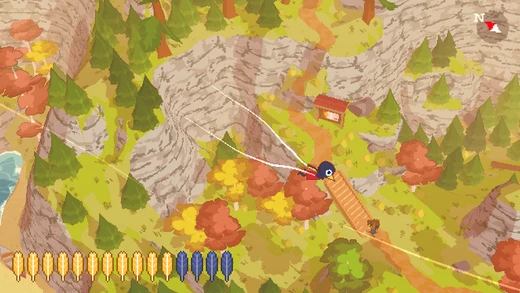
Open world
A game world where players approach objectives freely.

Wikipedia / Wikimedia Commons
An open world in video games is a virtual space where players can freely choose how to tackle objectives, unlike more linear, structured game worlds. Examples of this type include *Grand Theft Auto: San Andreas*, *The Legend of Zelda: Breath of the Wild*, *Red Dead Redemption 2*, and *Minecraft*.
These games usually do away with level-based barriers like walls, locked doors, or invisible walls that block movement in open areas. Instead, players are only stopped at the world's edges by natural obstacles such as vast oceans or impassable mountains. Loading screens, common in linear level design, are rare; the game world loads dynamically and seamlessly through strategic memory and storage techniques. However, open-world games still impose restrictions, whether due to technical limits or the need to maintain a linear storyline.
The core appeal of an open world is not absolute freedom—which current technology cannot fully deliver—but autonomy: the ability for players to choose how and in what order to approach challenges, within the game's rules. This autonomy is especially prominent in massively multiplayer online role-playing games (MMORPGs) and single-player open-world titles like the *Fallout* series. The main draw is a simulated reality where players can develop their character and behavior at their own pace, often without a concrete end goal, though a main storyline may exist, as in *The Elder Scrolls V: Skyrim*.
**Gameplay and design**
An open world is designed as a nonlinear area with multiple paths to an objective. Some games mix traditional and open-world levels. Open worlds encourage more exploration than smaller, linear levels, and reviewers often judge their quality by how interesting it is to interact with the world when ignoring the main objective. Some games model their open worlds on real places, like New York City.
A major design challenge is balancing player freedom with a dramatic storyline. Since players may act unpredictably, writers must find creative ways to impose a narrative without restricting freedom. This often means breaking the story into missions, simplifying the plot, or offering side-missions that don't interfere with the main story. Most open-world games make the character a blank slate for players to project onto, though some, like *Landstalker: The Treasures of King Nole*, offer more character development and dialogue. I
- field
- Video game design
- known_for
- Nonlinear, free-roaming game worlds that prioritize player autonomy
- key_mechanic
- Lack of level structures like walls, locked doors, or invisible walls
- design_challenge
- Balancing freedom with a dramatic storyline
Lore & Background
Games with open or free-roaming worlds typically lack level structures like walls and locked doors, or the invisible walls in more open areas that prevent the player from venturing beyond them. Only at the bounds of an open-world game will players be limited by geographic features like vast oceans or impassable mountains. Players typically do not encounter loading screens common in linear level designs when moving about the game world, with the open-world game using strategic storage and memory techniques to load the game world dynamically and seamlessly. Open-world games still enforce many restrictions in the game environment, either because of absolute technical limitations or in-game limitations imposed by a game's linearity.
Reader's Guide
The main draw of open-world games is about providing the player with autonomy—not so much the freedom to do anything they want in the game, but the ability to choose how to approach the game and its challenges in the order and manner as the player desires while still constrained by gameplay rules. A major design challenge is to balance the freedom of an open world with the structure of a dramatic storyline. Since players may perform actions that the game designer did not expect, the game's writers must find creative ways to impose a storyline on the player without interfering with their freedom. Some open-world games, to guide the player towards major story events, do not provide the world's entire map at the start of the game, but require the player to complete a task to obtain part of that map, often identifying missions and points of interest when they view the map. This has been derogatorily referred to as 'Ubisoft towers', as this mechanic was promoted in Ubisoft's Assassin's Creed series and reused in other Ubisoft games. The scope of open-world games requires the developer to fully detail every possible section of the world the player may be able to access, unless methods like procedural generation are used.
Did You Know?
- Open-world games typically lack loading screens when moving about the game world, using strategic storage and memory techniques to load the world dynamically.
- The term 'Ubisoft towers' refers to a mechanic where players climb a large tower to observe the landscape and identify waypoints.
- Rockstar games like Grand Theft Auto: San Andreas lock out sections of the map as 'barricaded by law enforcement' until a specific story point.
- The combination of open world and sandbox mechanics can lead towards emergent gameplay, complex reactions from the interaction of simple game mechanics.
Frequently Asked Questions
What is an open world in video games?
It is a virtual game space that lets players freely decide how and when to pursue objectives, rather than forcing them through a fixed, linear sequence. Well-known examples include Grand Theft Auto: San Andreas, The Legend of Zelda: Breath of the Wild, Red Dead Redemption 2, and Minecraft.
How does an open world differ from a linear game?
Linear designs funnel players with walls, locked doors, or invisible barriers that block movement and dictate a set path. An open world strips away those artificial boundaries, so the only things that stop you are natural features like vast oceans or impassable mountain ranges at the map's edge.
What is the key mechanic of an open-world game?
The core design principle is the absence of level-based barriers—no walls, locked doors, or invisible walls—giving players full freedom to roam and tackle objectives in whatever order they choose.
What is the main design challenge of open-world games?
Developers must balance the player's freedom to explore and act in any order with the need to still deliver a compelling, dramatic storyline that gives the world a sense of purpose.
Why are open-world games popular with players?
They prioritize player autonomy, letting you set your own pace, pick your own approach to objectives, and explore at will instead of being railroaded through a rigid sequence of levels.
More in Open-world video games 1-20
Spotted an error? Know more?
This is a living reference — every entry is fact-audited, and reader corrections feed straight into our audit queue. Suggest an edit · See this site's audit record